
2nd April 2026
The regard in which members of our royal family and other notable public figures have been held over the centuries has fluctuated between the extremes of unwavering admiration and utter contempt, with complete indifference occupying the middle ground. However, it was in the early part of the eighteenth century, with the introduction of the first of a long line of monarchs of German origin (starting with George I and continuing to this day) that a form of visual comment, the cartoon, came into prominence as a way of depicting the character and foibles of these personages.
At today’s talk, illustrated with many examples of the cartoonists’ art, we were hugely entertained by club member, Peter Stubbs, who had researched not only the original 18th century cartoonists but also those who have followed the tradition into the current 21st century. One of the earliest of these cartoonists was James Gillray, known as the father of the political cartoon. His work famously caricatured the generally unpopular Hanoverian kings George III and IV, and William IV, who were variously miserly, gluttonous, or otherwise decadent. The Napoleonic Wars (1803-1815) provided a rich source of material for the cartoonists of the time, many of them lampooning Napoleon himself but also depicting his British adversaries such as Lord Nelson and the Duke of Wellington.
Peter continued by discussing the political cartoons of later years – the Victorian era, with its many societal changes, and then the events of the twentieth century, chiefly the two World Wars. He showed many examples of cartoons which have appeared in publications as diverse as the much-lamented Punch magazine, Private Eye, and of course, The Times newspaper, whose brilliantly insightful cartoonist, Peter Brookes, is a master of his art.
As to the future, with the relentless decline in newspaper and magazine readership, the main stage for the political cartoon is likely to be the Internet. It is to be sincerely hoped that, in an ever more restricted and litigious world there will be freedom for cartoonists to continue the long-established tradition of visual comment on political and similar events.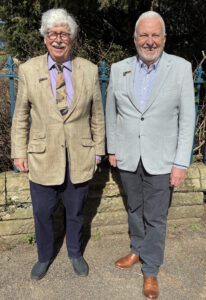
Peter Stubbs and Paul Davies
19th March 2026
It is now over two hundred years since the Napoleonic Wars raged across much of Europe but, remarkably, a collection of artefacts associated with one of the campaigns of that conflict has survived for all that time in the custody of one of our local families. At this meeting, club member Hugh Wright brought several examples of these artefacts. They had been handed down through generations of his family since the days when one of his ancestors, William Henry Wright, had fought against Napoleon’s army in the Peninsular War of 1808-1814. This particular phase of the wars in Europe took place in Portugal and Spain, with the British army supported by troops from those two countries.
Hugh described how his ancestor had joined the 4th Dragoons (a cavalry regiment) at the age of 18 in 1801 and progressed through the ranks until, by now a Captain, he embarked for Portugal in 1809. He then served throughout the Peninsular War under the Duke of Wellington until returning to England in 1814. During this time, Captain Wright was involved in several of the battles fought across Spain with the object of driving out the French invaders. Probably the most notable of these was the Battle of Salamanca in July 1812 in which the British and their allies inflicted a heavy defeat on their French adversaries.
During his talk, the speaker described his inherited collection which included a ceremonial helmet, belt, spurs, and war medals (one of which, a commemorative ‘clasp’, is being held by Hugh in the accompanying photograph). In the future, Hugh’s family members intend to offer these artefacts to a museum where they hope that they will be displayed for the enjoyment of the general public.
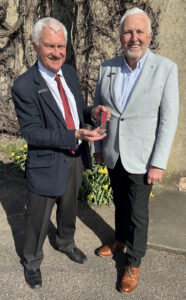
Hugh Wright and Paul Davies
5th March 2026
As in so many other aspects of life, the popularity of classical music composers can change remarkably quickly, such as that of Sir William Sterndale Bennett who was the subject of this talk by club member Kim Rainsford. In his day, Bennett was highly regarded by his Victorian contemporaries but, since the early years of the 20th century, his music has fallen somewhat out of favour with the public, although the New Grove Dictionary of Music and Musicians has described him as ‘A most distinguished English composer of the Romantic School’.
Kim started his talk by giving an outline of Bennett’s history. He was born into a musical family in Sheffield in 1816 but tragically, at the age of three, had lost both parents within two years of each other. Now orphaned, he was brought up in Cambridge by his paternal grandfather, John Bennett, a lay clerk to the choirs of King’s, St John’s and Trinity Colleges in that city. Having developed a remarkable musical talent, William, aged only ten, was accepted into the Royal Academy of Music where he remained a pupil for the next decade, learning to play the violin and piano. At the Academy, he also embarked on his career of musical composition for which, in time, he became greatly admired by other musicians of the day, including the celebrated Felix Mendelssohn.
In 1836, Bennett undertook the first of several visits to Germany where he and Mendelssohn collaborated musically and were members of a circle of friends that included another notable composer, Robert Schumann. At home in England, Bennett’s status was recognized by appointments as the Director of the Philharmonic Society of London in 1842, the Founding Director of Queen’s College London (1848), and Professor of Music at Cambridge (1856). He died in 1875 aged 59 and was buried in Westminster Abbey.
The speaker described the extent and variety of Bennett’s musical compositions of which there were a total of some 130, comprising choral and chamber music, symphonies, and works for piano. For all this prodigious output, Bennett has become a largely forgotten composer although, in 2016, to mark the bicentenary of his birth he was featured as ‘Composer of the Week’ on BBC Radio 3.
Paul Davies and Kim Rainsford
19th February 2026
Most of our speakers are members of the club itself, but, on occasion, a guest is invited to talk on a special topic. One such was this meeting, when the speaker was Robert Thornhill of Great Longstone, the current head of a long-established farming family in the village.
Robert described how his farming grandfather in 1912 had decided to concentrate on poultry production. Over the following few years, he had expanded his operations such that his flock reached ten thousand laying hens producing free-range eggs. In order to handle these quantities, he set up an egg-packing station, which was the first of its kind in Derbyshire. (An example of the sort of wooden boxes in which these eggs were sent to market is shown in the accompanying photograph). In time, the business turned to the production of poultry meat, which was a premium product, far more expensive than beef in the years before World War II. By the 1970s, Thornhill’s chicken processing factory in Great Longstone employed 450 people. In the meantime, Robert’s father (Peter) and uncle who, by then were running the business in partnership, decide to diversify, with Peter concentrating on cattle rearing from the 1950s.
After studying farming techniques in several countries, Robert joined his father in the family business. By crossbreeding Holstein Friesian with Jersey cattle, imported from New Zealand, they created a grass-fed herd of dairy cattle which produced milk of enhanced quality with a high fat content. Now in charge of the farm, Robert has a herd of 250 cows which he grazes on sections of his land in rotation, thus allowing the maximum growth of grass with the least damage to the ground. He described how he uses technology to monitor the growth of the farm’s pastures and the health of his animals. Along with his usual day-by-day farming activities, he is also clearly focussed on environmental matters, such as tree-planting and the restoration of the historic dewponds which are a feature of this limestone area.
It was clear to his audience that here was a farmer whose attitude and actions are worthy of far more appreciation by government and the public in general than is usually afforded them, and that they should be encouraged and supported.
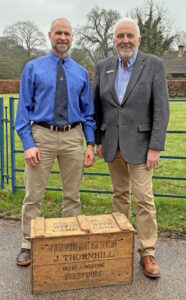
Robert Thornhill and Paul Davies
5th February 2026
As though on cue – but, in fact, by a remarkable coincidence – news of the assassination of Saif al-Islam Gaddafi, the most prominent son of the former Libyan leader Muammar Gaddafi, was announced on the day before this meeting to hear a talk by member, Tony Byrne, on his experiences of working in Libya during the 1970s when that country was under the firm grip of Gaddafi (senior).
The speaker opened his talk with a description of the geography and history of this North African state. It is the fourth largest country in Africa but, most of it is desert which means that the majority of its 7½ million population lives in the relatively fertile Mediterranean coastal strip. For many centuries a province of other Mediterranean powers such as the Romans, followed by the Ottomans and then the Italians, Libya gained independence as a kingdom in 1951. Eighteen years later, a bloodless coup led by Muammar Gaddafi deposed the king and established a republic which, in time, became repressive and the sponsor of international terrorism.
It was during the early years of Gaddafi’s time in power that Tony, at times accompanied by his wife and two small children, lived and worked in Libya. His first major civil engineering project was as part of a team to design a pipeline scheme, 300 km long, from an underground water source in the desert to the coastal city of Agedabia. This involved learning to survive in the hostile desert conditions of heat and frequent sandstorms. Following a preliminary design, the actual construction phase of the planned pipeline was postponed for many years when it was superseded by a far more ambitious scheme of supplying ground water to the whole coastal area.
Having finished work on the pipeline scheme, Tony was placed in overall charge of his employer’s Libyan engineering operations. Now based in Tripoli, it was possible for him to be joined by his family, and they spent the next five years living in the city. However, Libya proved to be quite restrictive in many ways and, with the children’s continuing education to be considered, the family moved back to England. That was in 1980. Since that time, Tony has never returned to the country which, as we know, has torn itself apart with civil war.
Tony Byrne and Tony Fry
15th January 2026
Throughout most of human history the loudest noises to which we were subjected would have been those of the natural world, such as a thunderclap or a barking dog, but none of these would have been a continuous source of sound for a long period of time. However, with the development of sound amplification systems it has become a far noisier world of sustained high-volume sound, one in which it is very easy for damage to be caused to our delicate hearing organs, the ears. Problems with sound systems and their effectiveness were the subject of this talk by Club member, John Thurstan, who related his experience of trying to achieve an acceptable sound system in Holy Trinity Church in Chesterfield.
As John explained, setting up a public address system should be quite simple. A microphone receives a sound which it converts into an electric current. This is then amplified, sent to a loudspeaker where it drives a paper cone which moves the air and makes the sound we hear. Alas, this is where problems arise because the quality of this sound depends on where the listener is sited; out of doors, or in a room with sound absorbent soft furnishings, or in a concert hall, or – worst of all – in an echoey church. It follows that the more reflecting surfaces there are in an indoor space, the more the amplified sounds will ‘bounce’ around and interfere with each other, resulting in a blurring effect for the listener. These difficulties can be overcome by careful siting of loudspeakers and the correct use of the microphones, but often only after a considerable amount of trial-and-error experimentation.
In his professional career, John had spent many years working in hospital ENT clinics and had thereby acquired a wealth of knowledge and experience in the workings of the human ear. For the second part of his talk, he described the physiology of this remarkable piece of equipment, and he showed how easily it can be damaged. He also explained how our hearing naturally deteriorates over time, but he stressed that we should avoid exacerbating this process by our own actions in overloading them with loud sounds. As he pointed out, ‘Taking your ears to a pop concert is like weighing an elephant on the bathroom scales.’ Surely, a sufficient warning to take great care of your hearing?
John Thurstan and Paul Davies